Category: 2026

for all post of 2026

  • 261003 Four projects

    Because I always have to wait for something to be delivered, none of the big projects is yet completed. So I am working on four big projects in turns depending on the parts I get. 

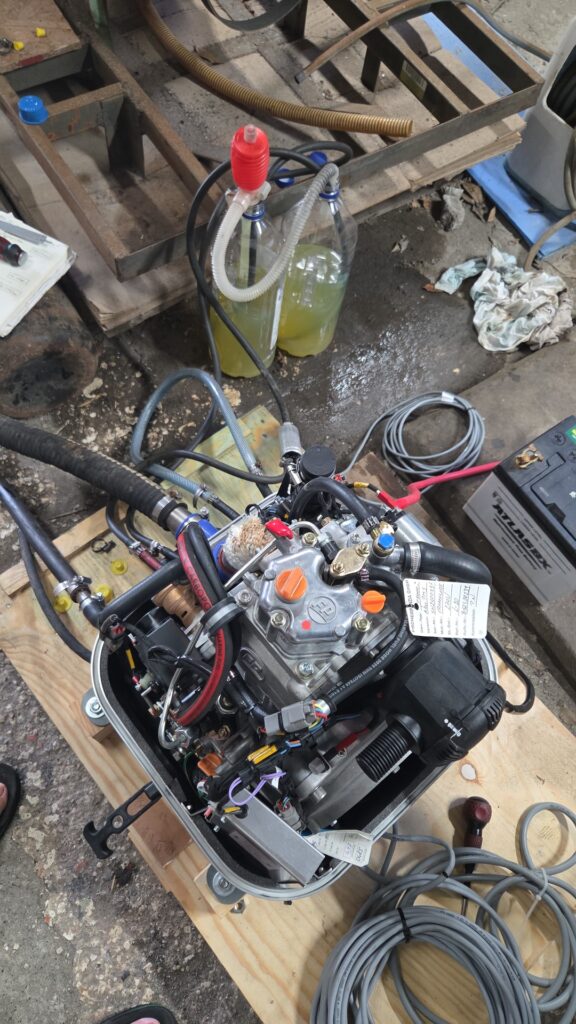
    The Fischer Panda generator project – All fuel hoses, the raw water hose, the coolant hoses are ready for being connected to the generator.

    The exhaust system took a while because I needed 2 parts, but now also the exhaust system is ready for connection to the generator. The exhaust system took a longer because I wanted to know the backpressure of the two waterlocks and the rubber hoses until the outlet outside the boat. For that I used AIs but they came out with completely strange results. Finally I found two data points in the manual, which enable me to calibrate the AIs result. With this, the calculated values went down. Both AIs (at the end I used only ClaudeAI and VipeAI) came back with more reasonable results. The final step was crucial. I gave both AIs the results of the other and asked for their opinion. It was very interesting to see how they compared their own calculations with the other’s calculation. Based on this new learning I asked them to re-do their own calculation. At the end the results of the static and dynamic backpressure where pretty much the same from both AIs and in the permissible range of the generator. This also shows again that AIs can be helpful but humans have to be the guiding brain and have to have the right understanding otherwise AIs will cause problems.

    Electrical connections of cables are not yet fully ready because I need to get two brackets to mount the 25 A – D-curve breaker before I get the generator in. These brackets are the current bottle neck for the generator project.

    LiFePO4 battery bank project – I am waiting already quite a while for the Victron DC-DC charger, the MK3 adapter to change the settings of the Multiplus charger for LiFePO4 batteries. The charger should have arrived yesterday and the MK3 adapter is scheduled to leave Australia yesterday. With the DC-DC charger on board, I can continue on this project. This is the last cabling and HW work to be done. The rest is settings of devices.

    Here I should mention the great help I got from a sailing friend and electrical expert, currently sailing in the Mediterranean Sea with his own boat. We met in 2022 when he sailed with his wife and friends with me in the San Blas Islands on the Caribbean side of Panama. Thanks Wolfi for your help and the kilometer long emails we exchanged. 

    Loose middle cleats – I observed that the middle cleat on STB has a bit of a play but I did not find the access hole to the cleat from inside. After the typhoon, which we weathered in Chichi-Jima, Ogasawara Islands the PRT side middle cleat was fully loose on one side. I thought the bolt was broken; now, I know that only the bolt has loosened. As I did not find the opening on the STB side I expected to have the same situation on PRT. I sent an email to Privilege’s Emmanuelle Mathis of the Delivery and Customer Satisfaction department to confirm that I have to open a whole to access the cleats’ bolts. As usually she came back with a good explanation. When I opened the cover on the PRT side, I saw that there is a hole already. Looking at the way the hole was cut and the work inside, I saw that the “technical expert” of the previous owner fiddled around there. Fortunately nothing seriously bad was done by this “technical expert”. From outside a bit of epoxy pate needs to used to close the upper part of the hole through the deck. At STB side there was no hole and measuring the position of the cleat’s bolts inside I dared to cut a hole. I got immediately good access to the bolts. I inspected them and hopefully already in the next week I can fix the cleats on both sides again. For this work I need to get a hand from one of the boat yard’s staff. 

    Vibration damper or rubber mounts of the watermaker – Here I got the new  rubber mounts already and started opening the watermaker. Now the bit tricky part needs to be done as soon as I cannot continue. 

    A bunch of minor boat jobs where done as well. Not worth to mention them explicitly but they needed to be done. 
  • 261001 Season of the my dear friends

    261001 Season of the my dear friends

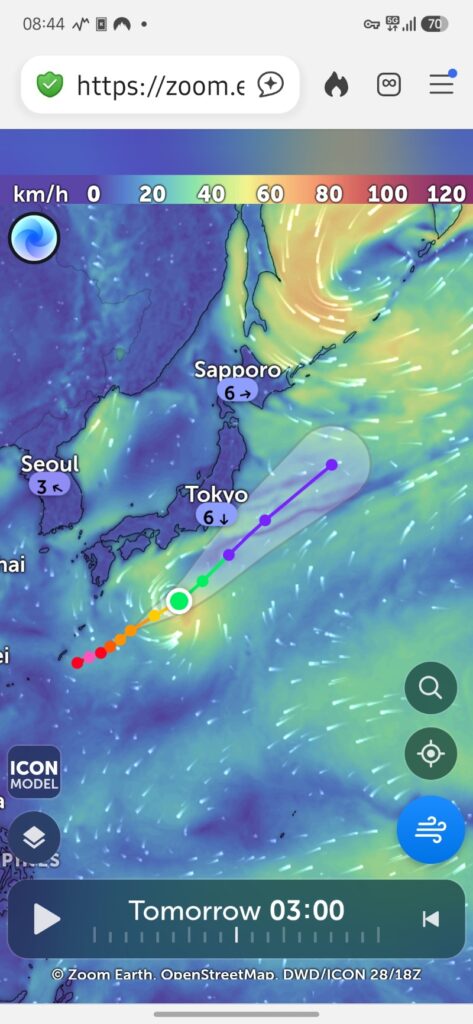
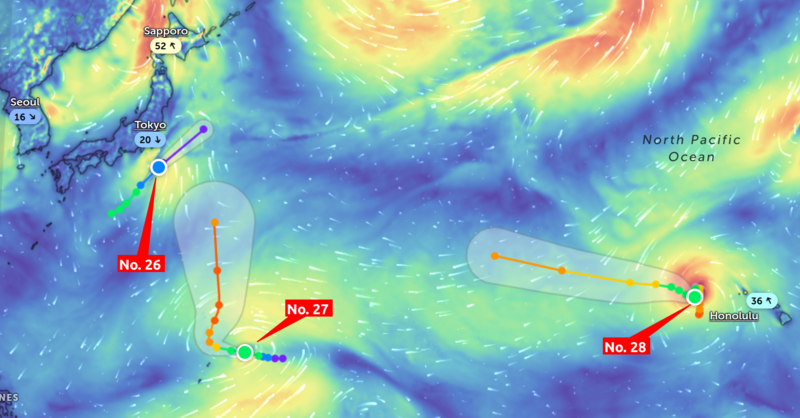
    This morning when I checked the typhoon situation I saw that the season of my dear friends is in full swing. Therefore a published the screenshot taken from zoom.earth directly as a the title image of this narration.

    Now we 2 more typhoons around towards Japan; two of them heading to Japan. On the screenshots I added the Japanese typhoon numbers. What I called No. 28 is not yet on the display of JMA, thus “No. 28” is currently my assumption not yet the official JMA numbering.

    I just hope that No. 27 and No.28 will change their directions more towards N otherwise they will become full hits.

    But both typhoons will bring a lot a rain to Japan. This is dangerous at land because the soil is already soaked with rain water, which can caused landslides. It will also cause floods again. The heavily concealed surface in metropolitan areas and the to small pipes of the stormwater drainage system cause regularly floods.

    Beside this, the autumn season is developing with its beautiful “koyo”, the “autumn foilage”. But most often it is just called “momiji” which means in the real sense of the word the “red maple leaves”. I like this season in Japan very much. 

  • 260929 My dear friend No. 26

    Since days I am watching closely me dear friend 26, the 26th typhoon in the NW Pacific this season.

    During 27th and 28th of September, it increased from a typhoon  to a violent typhoon and even to a super typhoon  and decreased down to a typhoon again. I the course of yesterday it became a severe tropical storm  and will degrade further to a tropical storm (wind speeds 90 km/h, 49 KN). Then it reaches areas with cooler water (sea water temperature below 26 degC) and the evaporation of water, the “food” of typhoons, will disappear. The typhoon simply starves.

    Some days ago the forecast indicated the dear friend 26 will stalk quite a bigger part of Honshu, Japan’s main island, including the area where MaRe is docked. These days I was pretty concerned. Now I’m feeling relieved.

    However, there is another “egg” of a typhoon, called an “invest” east of Guam and North of Pohnpei, Micronesia (go back in my narrations to Feb, Mar 2026 and you will find a few about Pohnpei). Currently it’s not known if the “egg will hatch”. I’ll keep am eye on it, I have to.

    How strong is wind of 50 or 100 km/h? While driving in a car, just open the window on such speeds and put your hand out. Now think about how small your hand is compared to your body and you will get a pretty good feeling how you would feel, being exposed to such winds. Finally image the wind goes up to 200 km/h and you get an impression of what a typhoon means and why I am sometimes calling the “my dear friend”.


    Side note
    A pretty good very early information about a possibility that a rotating wind, called an “invest”, can develop into a typhoon, is https://zoom.earth/maps/wind-speed/ . I found this homepage because the homepage of the Joint Typhoon Warning Center, a US Navy site, (https://www.metoc.navy.mil/jtwc/jtwc.html) cannot be reached all times and the JMA only publishes typhoons when are already developed and I want to know it earlier. 
    Using the above link you can see the ICON- and GFS-model based forecast world wide. You don’t need the app; just use your browser.

    About wind speeds of typhoon classes have a look at “260921 16:00 – What is my dear friend doing?” (https://sosx.de/cat-mare/blog/2026/09/21/260921-1600-what-is-my-dear-friend-doing/)

  • 260922 He was sufficiently gentle

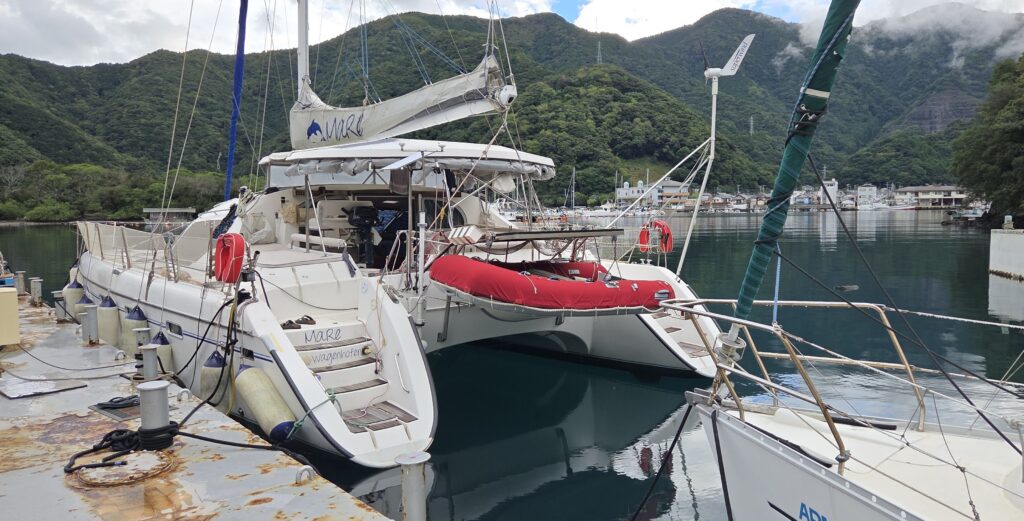
    Today, I was a bit nervous when I came closer to the boat yard where MaRe is docked. But no damage at her and I could not see any damage on other boats. The torrential rains cleaned her decks like a high pressure cleaner.

    I felt relieved!!!

    The dear friend was sufficiently gentle to MaRe and the boats around her although he caused quite some damage at other places in Japan.

    But he caused quite some traffic interruptions and this even today, when he was already gone out into the NW Pacific. Trains were not yet running normally. The train, I usually take in the morning, did not run until Shuzenji were I need to get off to drive the last hour to Arari by car. I only could take the train at 1208. 3 h later than the one I take normally.

  • 260921 16:00 – What is my dear friend doing?

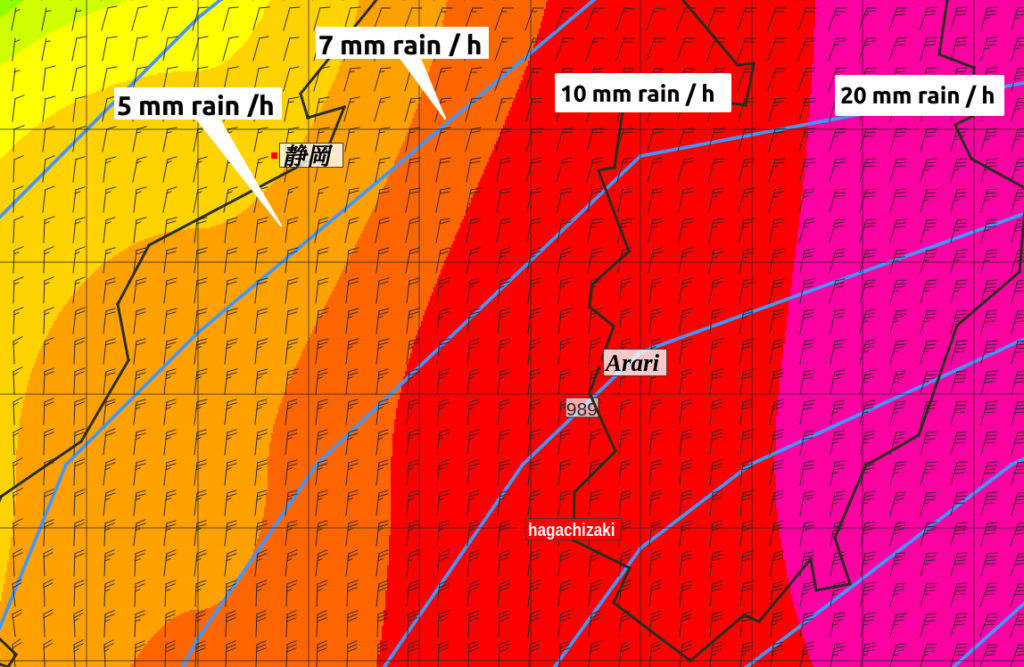
    Right now, at about 16:00 we have torrential rains in Tokyo. Comparing with the forecast the water which pouring down here is 20 mm / h. That’s a lot! It is the maximum color code in the GRIB file (weather file) reader.

    The national alarm system sent out several warning for Tokyo including the area where we live. It’s a pretty good system via mobile phones which should be introduced in other countries as well. The warnings include strong recommendations for elderly people to go to certain schools because the river can overflow or there are chances for mud slides even in Tokyo. Please don’t worry about us. We are living in a safe area about 20 -25 m above sea level and the Meguro River can never reach places as high as we are.


    But for me more important is what is happening around MaRe. The next image shows the rain situation as forecasted by the GFS (weather) model. You can see the purple area extends from Tokyo to almost Arari; the forecast says that 3 h ago the same rain poured down on her. Water from above is not a problem it only cleans traces of craws liking to sit on top of the mast, where I don’t like them to sit.

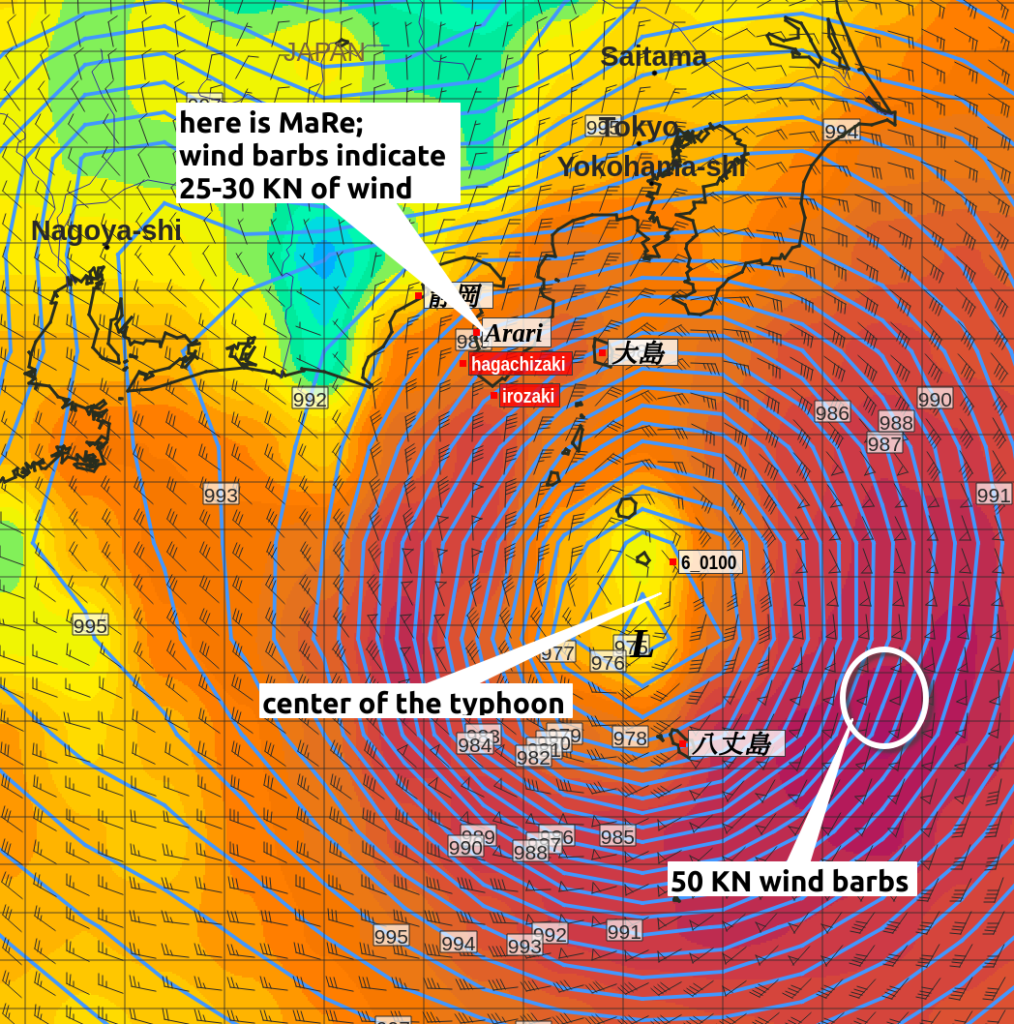
    What really concerns me is the wind around MaRe.

    Above image shows the forecasted wind gusts for 16:00. The center of the typhoon is clearly to be seen. The light yellow color indicates already a very low wind speed and the barbs, the arrows with the feathers at the end indicate only 10-15 KN of wind. The center of every whirlwind has a very slow wind. However, outside of the center, the wind blows like hell. In the NE to SE sector the wind is forecasted with 50 KN, this is almost 100 km/h. A pretty strong wind, in which I never want to get in. At MaRe the wind gust are said to be 25 – 30 KN. This is reasonable and nothing should happen to her. Right now, looking a the forecast I am feeling a a bit relieved. This is caused by the fact the typhoon is moving NE, thus has passed MaRe already and it was not a strong typhoon. 

    However the TV news indicate that the real wind is 10-20 KN stronger than forecasted.

    As trains are expected to run again tomorrow, I will see what happened to her.


    ***************

    Some information about typhoon classes as they are used by the JTWC (Joint Typhoon Warning Center) and JMA (Japanese Meteorological Agency):

    CategoryWind Speed (kn)Wind Speed (km/h)
    Tropical Depression< 34 kn< 62 km/h
    Tropical Storm34–63 kn62–117 km/h
    Typhoon64–117 kn118–216 km/h
    Very Strong Typhoon118–149 kn217–276 km/h
    Super Typhoon≥ 150 kn≥ 277 km/h


    According to this table of JMA it is not really a typhoon but a Tropical Storm. But names don’t matter, only the windspeed.

    Above table, I got quickly put together by Public AI, which is based is on Apertus, developed as part of the Swiss AI Initiative. This initiative is a collaboration between Swiss universities, including ETH Zurich and EPFL, and is supported by the Swiss National Supercomputing Centre (CSCS). Sometimes it is nicknamed “SwissGPT”.

  • 260920 A dear friend comes for short visit

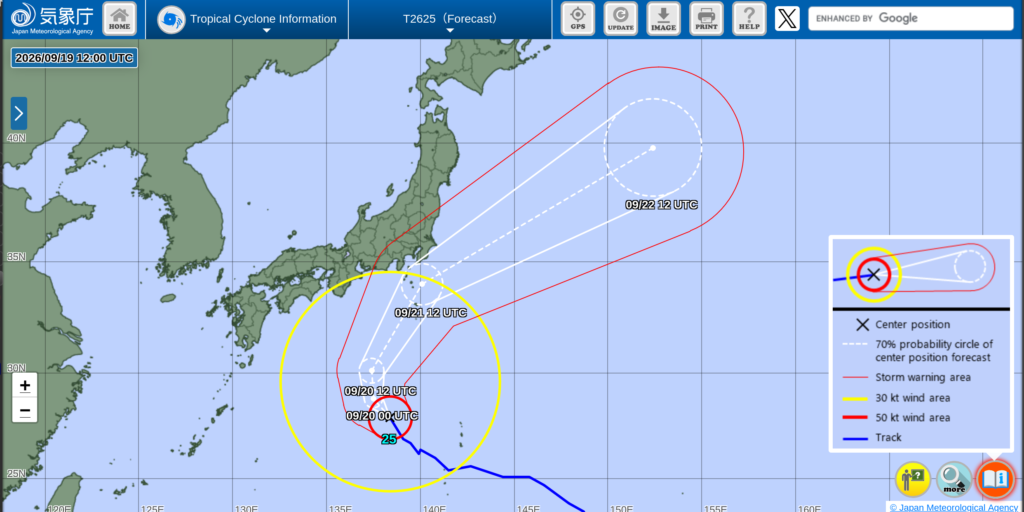
    There are visitors coming for whom I have to prepare MaRe especially. This time the visitor will arrive on the 22nd in the very early morning hours and is called “Dujuan” and has the JMA number T2625 or the Japanese number 台風25号, the 25th typhoon in this season in the NW Pacific area. Not all of them paid a visit to Japan. The Japanese naming with numbers starting every year from zero, I consider the best; the usage of names I consider as a bit impractical. 

    I prepared MaRe for it. All things in the cockpit are stored away. One additional bow line and an additional fender at the stern. Lines are tied up. Sail bag of the main sail is tied with a special line onto the boom. Cockpit is empty.

    When I look at other boats in the same bay, MaRe is pretty well prepared.

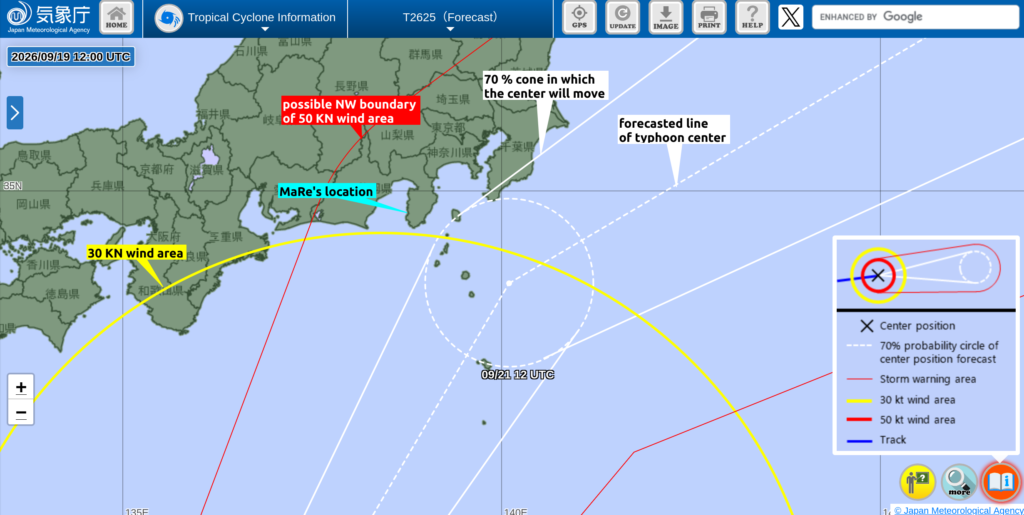
    According to the JMA forecast, which is the best available, there is a 70 % chance that the center of the typhoon stays within the white cone.

    The red circles is the area of winds of 50 KN winds and more. The red cone shoes where this area could pass and i don’t like this at all.

    The yellow circle indicates the winds with 30 KN. A bit on the high side but still kind of OK. I sailed several times with winds even above 30 KN. Once it goes above 35 – 40 KN it’s no fun anymore and out in the ocean I would go on a running course with strongly reduced sails and try to get mile for mile between me an the typhoons center. 


    Let’s see what the typhoon does!


    If you like to follow the typhoon you can do here (its the English site of the Japan Meteorological Agency): https://www.jma.go.jp/bosai/map.html#4/36.772/144.844/&elem=root&typhoon=TC2630&lang=en&contents=typhoon they update typically the chart every 12 h. Displayed time is alway UTC. In CEST you are now at UTC+2, Japan is UTC+9. You can look for the UTC time of your city here: https://www.timeanddate.com/time/zone/japan/tokyo and look for your city.

  • 260914 Time for an update – new generator

    Work is progressing on several projects. This narration is about the installation of the new Fischer Panda 5000i Neo generator. (For technic freaks: https://www.fischerpanda.de/en/products/marine-generators-for-boots-und-yachts/perfect-power-generators-with-variable-speed-technology/perfect-power-i-serie-230v-50hz/panda-5000ineo-pms) It turned out to be a bit more complex than I expected, but step by step I’m solving the problems.

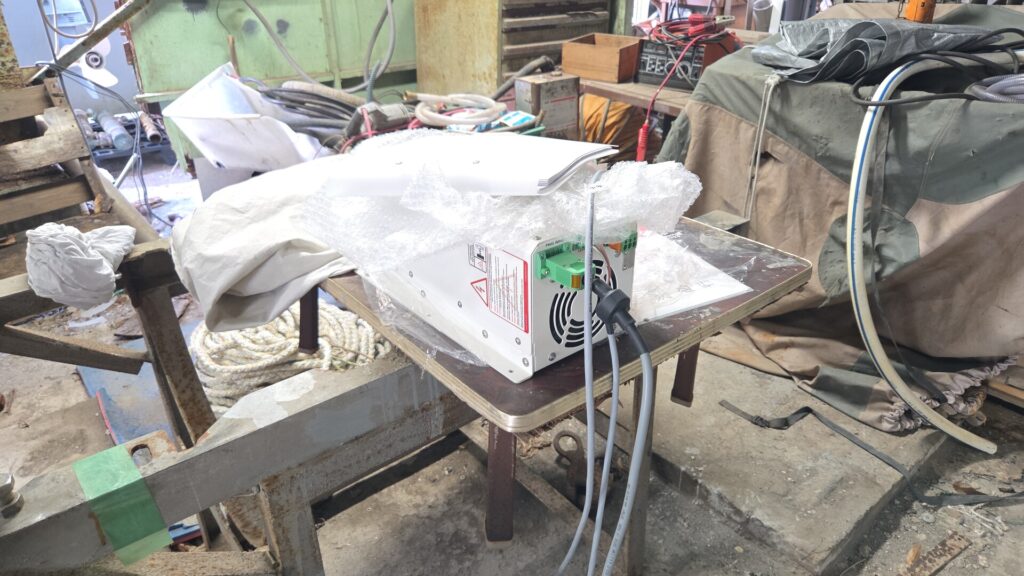
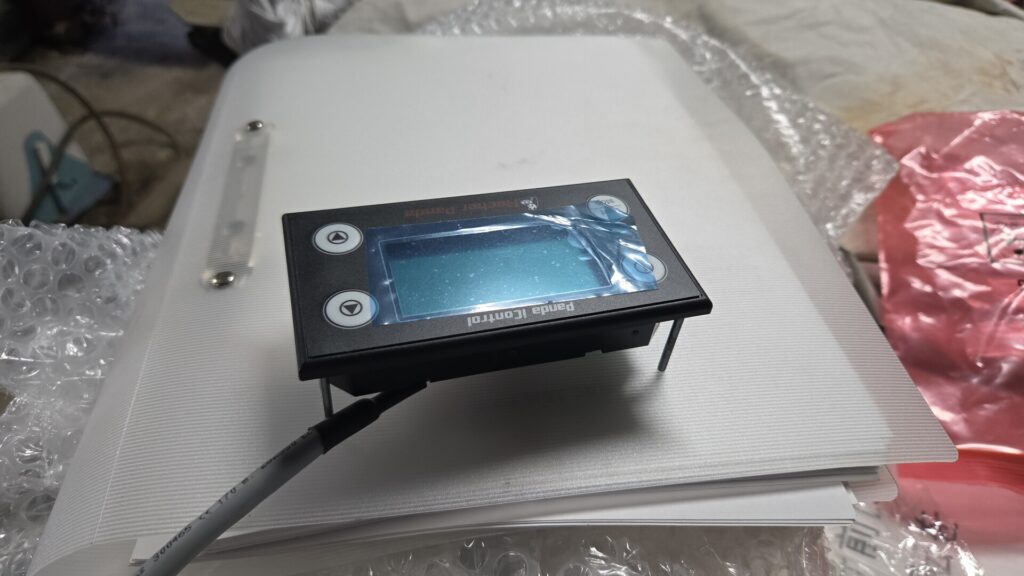
    In the meantime the external fuel pump is installed and the fuel hoses (feed and return) are connected to the old ones and ready for connection to the new generator. The same is done for the raw water (sea water) supply hose and the coolant supply and return line. The inverter is mounted and the layout of the electrical cables decided. The remote operation panel is built in. I added a Deutsch connector to a short piece of remote panel cable and connected it to the remote connection cable of the old generator. Using the old remote cable saved me at least a day of work to replace the old cable for a new one. (About Deutsch connectors: https://en.wikipedia.org/wiki/Deutsch_Group) The newly needed Deutsch connectors and the crimping tool I found at the web outlets monotaRO (https://ja.wikipedia.org/wiki/MonotaRO) and Rakuten (https://en.wikipedia.org/wiki/Rakuten).

    One of my headaches was the installing of the shock mounts, the vibration dampers, for the new generator on the platform. To access the equivalent mounting screws for the old generator was always very troublesome. I needed to remove a few parts of the Volvo engine to just reach far enough under the platform. While I was thinking about the needed again removal of the saildrive parts, I had a flash of inspiration. The new generator is mounted not on top of a baseplate covering the platform, but only on four “legs”. This means that I can reach the bolt-on spots for the shock mounts if I make a hole in platform. Making a 15 cm diameter hole in my cardboard template to position the generator on the platform, I could test, if I can get one arm through this hole and reach the spots where the shock mounts need to be fixed. As the test was positive, I started with opening the hole on the platform. When I had to leave, I asked Kikuchi-san of ASB (Arari Ship Builders) to please complete the opening and seal the edge of the hole with glass fiber material. The result I saw when I came back to the boat was perfect. He even painted the platform newly.

    In order to protect the 230 V circuit from any current surge from the generator, I need a 25 A breaker. This simple thing turned out to become a major work. The breaker is not more specified by Fischer Panda than with “slow fuse, max 25 A”. As I don’t want to use a fuse, which will blow in the middle of the ocean, I want to install a suitable breaker. I sent an inquiry to support at Fischer Panda got in contact with a supporter in the USA. The information I got from him was less then what I knew already. Perfectly useless!

    Beside the 25 A slow fuse limit in the generator manual I know that the watermaker needs 230 V, 3 kW power. Starting the watermaker results in a sudden very short surge of current, which may not trip the breaker.

    Looking at the homepages of Japanese breaker manufacturers, I had no clue about which breaker I need to select.

    So I asked AIs and in these long chats and from information I got from a sailing friend in Germany, who happens to be an expert in electricity, I could develop the 4 important specs for the needed breaker.

    Because AIs can search the web very fast, I asked the five AIs to search me a breaker from Mitsubishi Electric, Fuji Electric, Panasonic based on these four specs. They all came back with different breakers and non of them was matching the given specs. I wasted a few hours without any success. AIs can fail is the statement made for all AIs and this is true. I clearly saw the limits of the AIs being available for normal people. In this case they were absolutely useless and I lost a lot of time.

    I decided to contact the Japanese manufacturers directly, and Siemens Japan as well as ABB Japan. The company from which I did not expect much from came in with the first reply, an exactly specs matching breaker, and a sales outlet in Japan. As the other companies replied late and I wanted to make a checkmark behind the purchase breaker task, I ordered the Siemens breaker and made my checkmark.

    However, I need to mention Terasaki, an Osaka based breaker manufacturer. I got in touch with a sales rep already earlier. The sales rep did the best he could do but Terasaki doesn’t make 25 A breakers. With 20 A I can’t charge the batteries while making water, and with 30 A I’m above the generator specs. To help me as much as he could, he made me a contact to a shop for ship electricity in Arari. I’ll visit the shop and buy the piece of cable to connect the breaker to the 230 V board network and the inverter.

    The final topic is one I still have to deal with. How to get the mixture of exhaust gases and raw water out. I have an installed hull through, an exhaust hose with swan neck, and a waterlock from the old generator with a 50 mm inner diameter. The Fischer Panda generator has an exhaust outlet of 40 mm diameter. The same for the in- and outlet of the Fischer Panda waterlock.

    Waterlocks protect the engine of the generator from cooling water flowing back through the hose into the engine when the boat moves in waves. (The cooling water is the raw water, which passed through the heat exchanger of the diesel engine and enters at the engine’s exit of the exhaust gases into these gases, cool them down additionally and existing the boat through the exhaust hose via the hull through, the outlet at the boats wall. )

    As the volume of the Fischer Panda waterlock is on the limits for the installed hose to the hull through, the exit of the water on the boats wall, I want to use the waterlock of my old Onan generator additionally because it can hold back all the water in the hose after this waterlock.

    However, there is a static and dynamic pressure in an exhaust system and each waterlock adds it’s own resistance to the outflowing exhaust-gas-water-mixture. This increases the complexity of the exhaust system.

    For every problem there is a solution and I am curious how I will solve this one.

  • 260821 Genset test run

    Fischer Panda recommends to test run the genset before building it in.
     

    So we did it. The setup reminded my to an experimental setup during my days in university research. That time, we considered the setup as perfect when it only holds together until the last measurement was done – after that, it can collapse.

    Two old water bottles one with some diesel in it and one for the diesel reflow. A hand siphon pump to pump returning diesel into to bottle which functions as the diesel tank. The electrical fuel pump just somewhere in the fuel feed line and connected to the 12 V power supply from the genset. For the coolant inside the engine, we made just a close circuit with a piece of a hose. As the return line has a smaller diameter we got a lost some coolant because we got a temporary leak. The raw water input, which normally gets sea water was connected to a fresh water line. The exhaust exit of the genset got an old piece of rubber exhaust hose to keep the exhaust fumes and the exciting raw water away from us. The electrical

    connections to the inverter were made with the long cables supplied. The same for the control panel. Only the battery cables we used were already made in the length as needed for the installation at MaRe.

    Oil check showed the right oil level. Thus, all ready for the final steps. Connection of an old 12 V battery to power the start motor and supply the engine control board. The control panel displayed readiness of the system.

    A push of the start button and the engine control board took over, started the fuel pump and a few seconds later the start motor. The diesel engine started and was running fine. Another few seconds later the inverter switched on its green OK-light.

    The final test was to see if the inverter delivers 230 V. A multimeter connected showed 230 V. The only thing we could not test was the current from the inverter because we did not have a suitable device for an electrical load.
     

    We considered the test as successful.

    As we had only a reduced amount of coolant in the engine, the engine temperature went up after a few minutes and we switched off the genset. Test was completed and the experimental setup held together until the end of the test.

    Like in the old university days!

  • 260820 The Yoshimuras

    I also met some very nice people here at the Arari Ship Builders pier – the Yoshimuras. They came to MaRe because a catamaran is not that often to be seen in these waters.

    I invited them for a cup of coffee on board of MaRe being in maintenance mode, which means many tool boxes, and many other things are stored temporarily in the cockpit. We had a good time talking about boats and times at sea. At the end I got invited to have lunch with them. Thanks for the delicious meal Michiko, and to all of you for your hospitality and the interesting conversations we had.

  • 260818 Work in progress

    Hours after arrivai and even on a Sunday, Iwabuchi-san discussed with me the work I want to do with stuff from ABS.Beside this there is plenty to be done for me on my own.Immediately on Monday morning I started disassembling the Onan genset (combination of a diesel engine and a generator). On Wednesday we used the boom as a crane to lift first the diesel engine and then the generator out. I then removed the base plate and cleaned the hole engine room area. Then came the detailed planing on how to install the new Fischer Panda genset and its peripherals. It’s a bit tricky as the connections for exhaust, fuel, coolant, raw water and the electrical connections are just the other way round as at the old Onan genset.Finally I decided to extend the original tubes for exhaust, fuel, fuel return line, raw water and get the extensions under the installation platform to the left side of the genset. For the cables an existing cable duct and the connection to the charger and the control panel can be done using the existing cable from the Onan genset. This saves a lot of work. The waterlock of the Onan genset can be used as well; only a reduction tube to match the diameter of the old exhaust tube with the smaller one of the new exhaust tube is needed. Kikuchi-san will look for a solution.

    A bunch of other smaller things are done or work on progress.

    One of them is a re-coating of my Rocnan anchor. It will be white now.


    And I got now 200 V shore power; a special connection for MaRe.